Opinion
AI Research Engineering skills
The Engineering Layer for AI Research Agents
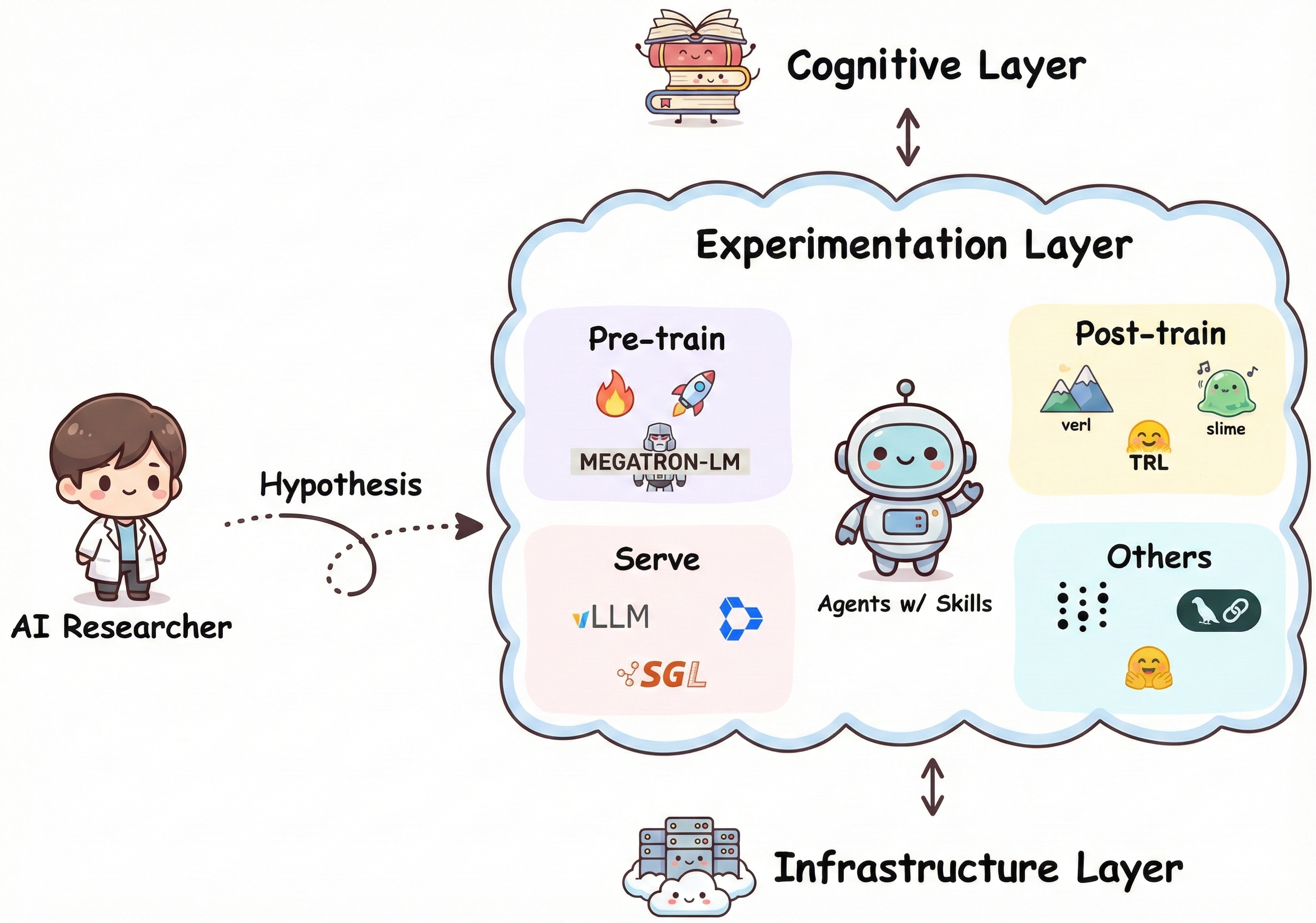
Today's AI research demands excellence in two distinct areas: algorithmic innovation and systems engineering. Unfortunately, the systems side often becomes a bottleneck for scientific progress, as researchers spend valuable time wrestling with distributed training configs and data pipelines instead of iterating on their ideas. While AI coding agents promise to help, they frequently stumble in this specialized domain. General-purpose programming capability is not enough when the software ecosystem moves this fast; an agent might write valid Python, but it often lacks the deep, up-to-date context required to navigate the complex, rapidly evolving tools used in modern AI experimentation.
This is the motivation behind our AI Research Engineering Skills Library. We built this open-source project to empower coding agents with the specific, modular engineering knowledge they need to act as capable research assistants. By covering the entire experimental workflow—from preparing high-quality datasets to configuring complex training loops and conducting rigorous evaluations—this library enables agents to handle the heavy lifting of infrastructure software. This allows researchers to stop fighting with frameworks and focus entirely on the science.
Skills LibraryIntroducing the AI Research Engineering Skills Library
Our AI Research Engineering Skills Library is the most comprehensive open-source library of AI research engineering skills—designed to empower AI agents to autonomously conduct AI research via end-to-end scientific experimentation—preparing datasets, executing training pipelines, deploying models, or analyzing results—just like a real researcher. We believe this is one of the most important puzzles towards real AI Research Agent.
Our focus is on quality over quantity (82 skills across 20 categories). Each skill offers comprehensive, expert-level guidance complete with real-world code examples, troubleshooting guides, and production-ready workflows.
Quick Install (Recommended)
Use the interactive installer that auto-detects installed agents and offers installation by category or individual skills:
npx @orchestra-research/ai-research-skills
Claude Code Marketplace Alternative
Install individual skills directly from the marketplace:
/plugin marketplace add orchestra-research/AI-research-SKILLs
/plugin install fine-tuning@ai-research-skills
The Philosophy Behind Skills
Think of skills as invocable knowledge packages—modular units that contain structured instructions, references, and resources for a specific domain. This concept—pioneered in the transition from Claude's claude.md to skills—marks a new era of modular intelligence. Regardless of future model architectures or context window sizes, this design principle will remain a cornerstone of AGI: separating lightweight reasoning from heavy resource retrieval.
Key ideas:
- •Instant invocation mechanism: Instead of loading all tool descriptions into the model at once, a dedicated tool retriever dynamically searches and loads the right one when needed—just like browsing functions in a directory.
- •Reduced context burden: Tool information is injected only when relevant, avoiding context overflow and resource waste while improving reasoning focus and response efficiency.
- •Higher precision and quality: On-demand loading ensures the model only uses the most relevant tools, reducing interference and miscalls, leading to more focused and interpretable outputs.
- •Simplified version management: Tools can be updated or replaced directly without complex version control, keeping the system lightweight and flexible.
Imagine giving Claude—or any advanced model—a set of skills encapsulating a financial analyst's tools, experience, and workflows. You'd essentially create an AI financial analyst. Extend this to every knowledge domain, and a Skills Marketplace becomes a true digital labor market, capable of simulating any professional role.
As Dario Amodei once emphasized, the simplest solutions often scale the furthest. Skills are precisely that: a simple but transformative step toward general intelligence.
Research Skills in Production
Demo: Reproducing Cutting-Edge LoRA Research
Want to see these research skills in action? I used the GRPO-RL-Training and PPTX skills from this library to reproduce Thinking Machines Lab's cutting-edge LoRA research—complete with GPU provisioning, experiment tracking, and automated presentation generation.
In just 2 days (instead of the typical 2-3 weeks), I validated their findings on both supervised fine-tuning and reinforcement learning tasks, generated publication-ready plots, and delivered a comprehensive analysis—all through natural language conversations with Orchestra.
Read the full demoDemocratizing AI Research
We open-sourced this collection of AI Research Engineering Skills because we believe that AI research should not be a privilege any more. Our goal is to democratize the entire AI research workflow, making it accessible to anyone with curiosity, not just those with compute clusters or elite research engineering teams.
By encapsulating AI research engineering knowledge into reusable, modular, and invocable skills, a student, a startup founder, or a cross-disciplinary researcher in a developing region can now use the same experimental capabilities as top AI labs—launching large-scale training, evaluating models, and running reproducible experiments with the help of AI agents.
A Future Without Gatekeepers
We envision a future where every individual can contribute to AI research, where the frontier of science is no longer gated by hardware or institutional privilege, but powered by collective intelligence and creativity. The AI Research Engineering Skills Library is our contribution to this vision—a step toward a world where groundbreaking research is limited only by imagination, not resources.
Explore the AI Research Engineering Skills Library on GitHub,
and start conducting AI research experiments by just prompting Orchestra Research.